For clarity, I suggest that you read the Prayer Rock –Part Two.
I had the right breast biopsy where it was determined that I had breast cancer on October 3, 2006. On October 13, 2006, I was again under the hands of Dr. Chapman, who would conduct the sentinel node biopsy and mastectomy of the right breast. As I write this some 15 years after the fact, I read recently that there is a new protocol for conducting the sentinel node biopsy and that it seems to be more effective and cut down on some of the side effects that many women have. The field of breast cancer research and treatment has changed so much and so much more is known since I had my diagnosis and I am so thankful for that. That’s why I support the American Cancer Society and Relay for Life.
We met with Dr. Chapman in his office a couple of days after the biopsy and made the decision to have the mastectomy the next week. I had not shared with my co-workers what Dr. Chapman had told us after he removed the lump and found the tumor. But when I went back to work after meeting with him, I remember walking into our office where the ladies who ran the school district worked and saying to them, “ Well, ladies, this is October and it’s Breast Cancer Awareness Month. You know me .I don’t do anything halfway so I went out and got myself breast cancer! “ After we laughed and cried, I got down to the business of my job as a Curriculum Coordinator in charge of many programs for our school district and went my merry way, acting like nothing was wrong and that I didn’t have a care in the world. My motto was the old, “Never let ’em see you sweat”. I spent the next few days getting things cleared off my calendar so I could be out several days,. I am/was a workaholic but I loved what I did and the saying is true that when you love what you do, it isn’t a job. During that period, I managed to sublimate my fears and carry on as if nothing had happened. The mind might think that it has successfully conquered fear, but the body knows! I was to find that out.
We arrived at Mary Black Hospital early that morning of Oct. 13 after the required “nothing to eat or drink after midnight”. This begins the series of events that I can only attribute to God looking out for me and answering prayers in a way that left NO DOUBT in my mind that He was with me.
I was in a holding room waiting to be hooked up to the IV for the procedures to begin.I was by myself as my husband could not come with me from that point on. I have very small veins in my hands and I was dehydrated. I was also freezing cold, even though they had provided a warmed blanket, and that made what veins I did have shrivel up like a dried prune. My saga began when the first nurse came in to start the IV line. She rubbed and massaged and finally found a vein but when she inserted the needle, the vein promptly rolled and blew out. This hurts me to write about it because it was painful. They had to use the left hand because the surgery was going to be on the right side so it could not be used. The nurse put a warm cloth on my hand and tried again to get a vein. She could not. She left and got reinforcements, this time a “seasoned nurse” who seemed confident she could get the needle in my hand. She too was unsuccessful. At this point my hand was covered with bandages and I had just about had enough. The two nurses put their heads together and I heard the words “IV team and cut down” as one of them was poking around on my lower leg and ankle. My sister was a nurse and I had heard about cut-downs from her and I began to be terrified about this. The older nurse said they were going to let someone else try and if they couldn’t find the vein, they would have to call the IV team. I don’t fault the nurses at all. They were doing all they could do with as much care and concern as they could.
The nurses left the room and I began to pray……”Dear God, just let them find a vein. That’s all I want–just a little vein that won’t roll and won’t blow out and won’t HURT when they find it. Just a vein God, just a vein, please! “
After a few minutes a very young RN came into the room. In fact she looked somewhat white around the gills and told me they had asked her to try to find a vein. She looked apologetic and said that she had only been on the job for a couple of days. She said she was sorry in advance if she hurt me. I really felt sorry for her but I continued to silently pray for a vein.
She picked up my hand and looked at it, shook her head and said, “Well, I don’t understand what the fuss is about–look at that big old vein sticking up there” and before I knew it, she had the needle in my arm and all was well. I said to her, “Sweet girl, I prayed to God to let y’all find a vein and God answered my prayers. Don’t ever doubt the power of prayer!”
So having passed that hurdle, I began to get warmer and somewhat relaxed. At this point, I want to state that I had an IV needle in my arm and a saline solution bag ready but NO drugs had been given to me. I was fully awake and aware. In the next few minutes, an orderly moved me on the gurney to another “holding room” where I would wait for the sentinel node biopsy. It had to be done first in order to see if cancer cells had spread to the lymph nodes.
The sentinel node biopsy involves radioactive dye injected in the lymph glands in the breast with a needle so that the dye can move into the lymph nodes. I had not wanted to think about the procedure since thinking about needles injected into the breast is not something one wants to think about so I had pushed that deep into the recesses of my mind.
As I lay on the gurney in the room by myself, the only way I can describe what happened next was that the bottom fell out. All the fears about cancer and what the outcome could be, all the fears about the procedures I was to have, all the doubts and questions that I had kicked to the back of my mind and tried to ignore as I put on a happy face , had come to the surface with a roar. I began to shake all over to the point that had the bars on the side of the gurney not been up, I would have literally thrown myself out of the bed because I was shaking and trembling so hard. I had to hold on to the bars to steady myself.
At this point, it seemed to me that I was falling into a deep dark place, an abyss where no one was, I felt so alone. I felt that I was totally abandoned and without help. Realizing that I had to somehow get control of the situation, I cried out to God. “Please help me God! Please help me to calm down and please help me to move from this terrible place. I feel so alone and lost. I feel that I am fighting this by myself. I can’t do this alone. Please help me.”
At this point when I share this event, I want to remind the reader that I did not have any drugs in my body. All I had was an IV drip of saline.
As I lay there shaking and trembling, freezing to death, about to hyperventilate—I sensed a presence near my right shoulder and my right ear. Out of the corner of my eye, over my shoulder, looking down on me, I sensed a young man standing there. I can’t describe how he looked. Only that there was a presence there and it was a young man. His voice spoke softly in my right ear. This is what He said:
“Cathy, now you know how my Son felt in the Garden of Gethsemane when he was left alone to bear the burden of his death and the sins of the world. Now you know how he felt. Cathy, IT WILL BE OKAY.”
Immediately, I felt a warmth that started at the top of my head. It moved down my body, and as it did, my trembling and shaking stopped and a feeling of peace and calm took over. I can only describe it as being covered by a warm blanket that felt like a thick liquid. As it moved down my body past my chest and torso and down my legs, the fear left me and a sense of calmness was all that I felt. I knew then that whatever the outcome of this journey was going to be, it would be OKAY because God assured me it would be.
As I lay there, reflecting on what had just happened, I knew that I had to share my experience but I wondered if people would think I was crazy or on drugs. No, I was not either of those I had been visited by the Holy Spirit, our Comforter, our Sustainer, our Hope in troubled times. My faith had been bolstered by His presence in the hospital room.
Shortly after this happened, the radiologist who would do the injection for the sentinel node biopsy came and rolled me across the hall. He asked me how I was doing and I shared that I was a little nervous about the procedure but that I was okay. I remember he said, “Every needle stick is different and every person is different”. He got me all draped and got into position. I could sense movement and kept waiting for the pain of the needle sticks. All I felt was a few little pinpricks. After a few minutes, he announced that he was finished. “Finished? That’s it?” I exclaimed. Once again, God had come through for me and shown me that with Him there is nothing to fear.
Once I got the IV in and got past the sentinel node injections, the rest was a piece of cake for the most part. I had fears, of course, of what the sentinel node biopsy would reveal since it would determine if the cancer had spread to the lymph nodes and beyond. But I did not fear what was to come because I knew that God had told me in no uncertain terms that it “would be okay.”
Thankfully, my cancer had not spread to the lymph nodes, however it was estrogen positive and HER2NU positive. HER2Nu is an aggressive form of breast cancer that required an aggressive form of treatment but all that would come later when I met with my oncologist at the Gibbs Cancer Center in Spartanburg, SC. My decision to have the mastectomy first before consulting with an oncologist is probably not the route that was the best and if I had it to do over again (God forbid!) I might do things entirely differently. But then again, I might not. I was firmly under the conviction that God wanted me to have the mastectomy first and since the cancer I had was aggressive, who knows what the outcome could have been had I waited? The bottom line is that every woman or man, has to make the decision that she feels is best for her and she has to advocate for herself and listen to her body, A mammogram did not show the tumor that I had and had I not followed my heart and what I believe God was telling me to do, I fear that the outcome would not have been good. I relate all that in the Prayer Rock Part Two.
After I met with my oncologist at Gibbs, which at that time was affiliated for consultation and tumor board review with M.D.Anderson, a course of treatment was prescribed. I was asked several times why I didn’t go to Duke or Emory or M.D. Anderson. My response was that my tumor did go to Houston, just without me!
As I reflect on this post, it has been 15 years since my diagnosis. I went through 3 rounds of chemotherapy, 8 rounds of what was supposed to be 12 of Taxol, and 18 months of Herceptin infusions. That was followed by 5 years of taking Arimidex and now a bone loss drug with breast cancer fighting properties, Raloxophene, part of the Tamoxifen family.
Going through the chemo was an experience and certainly not a walk in the park. But I was fortunate to tolerate it better than most and I had the most wonderful support system with my husband and sons, my co-workers, and my church family. We didn’t want for anything. Our freezer was full of delicious casseroles. My taste buds were affected during chemo, though. I described it as almost like being pregnant and having food cravings. I craved spicy foods sometimes and other times all I could tolerate was the delicious chicken noodle soup that our local sandwich shop made. I love to tell how even on days when it was not their soup of the day, my administrative assistant,who was my rock and my savior, would go by the establishment and they would give her chicken noodle soup to bring to me. There’s nothing like a small town taking care of its own. I spent from Dec. 11 until Feb. 20 at home. I was going through chemo and while I wanted to go to work some days, my husband, bless him for his wisdom, took my car keys away and forbade me to go to work. He was right, of course, because all my focus needed to be on the fight I was going through, However, my office was able to set up a remote desktop for me where I could work from my computer and “see” everything on my desktop at work–far ahead of the game for 2006!!! On days and nights I felt like it, I could work on a big project that our school district had going on for which I was responsible. Many times, I would be working at 2 or 3 o’clock in the morning because the steroids that were given with the chemo to keep reactions from happening would keep me awake for a day or two, after which I would crash. But it kept my mind off things and I could still take care of my body without feeling I was letting folks down.
As I write this during what is almost the end of Breast Cancer Awareness Month, I look back on the experience, not with regret or fear, but with a sense that things happen for a reason. There are many things that I can say about my experience and why I think it happened to me. I have said many times, “Why not me? Who did I think I was, that breast cancer would just decide to skip over me?” And why not me instead the young mother with children at home, no insurance and no support system, her life in front of her? If one in 8 women are going to get breast cancer, I was okay with being that one if it meant another one who did not have the resources I had did not get it. I think that as humans we all struggle to understand why things happen. This is how I have decided to understand my journey with breast cancer. In the great scheme of things, why not me?
As for looking for the positives, I finished my 46 year career in education by serving for about 9 years as the Personnel Coordinator for our school district. During that time, I was able to be a source of encouragement, help, support, and empathy for many of our employees who were going through their breast cancer journey. I had been where they were. I could encourage them, cry with them, fight the fight with them, and show them that I was there, still kicking, and they would not be in this situation forever. Sadly, several dear friends and colleagues lost their battle, but many more are still working and living their lives to the fullest.
I was recently invited to share about my foray into making jam and jelly with a club in my hometown of Inman, SC. Here is the presentation as I spoke it to the ladies, many of whom I have known all my life, went to school with, and worked with.
When Cindy asked me if I would speak to the Women’s Club about making jams and jellies I had to laugh. I thought, y’all must be hard up for program speakers!
She left me a voice message and said that I was a guru in the kitchen and home and I had a lot of good stuff to share. I do put a lot of things on FB and Instagram about things I have cooked, flower arrangements, gardening activities and the like. I believe in flooding social media with positive things instead of what we are getting…..
I am no Brenda Gantt and I am sure not Ina Garten. I am just an old retired teacher who has finally had time to do all the things that I wanted to do for years but never had the time to do.
I know many of you understand.
In fact, I couldn’t boil water when I got married. It was just my mother and me from age 13 on as my father passed away when I was 13. She didn’t work outside the home and always had food prepared. I guess if I had had siblings closer to my age instead of all older and moved on, and more to do around the house, she would have had more expectations.
As it was, I was too busy riding my horse and being a tomboy to learn to cook.
LEAD Technologies Inc. V1.01
I did know how to make tuna casserole when we married because XXXXX and I were in classes at Limestone College together and I would go to her house between classes and she taught me to make that.
Over the years, I did learn to cook pretty well because I had two good role models in my mother and Real MaMac–Ruth McMillan, my mother-in-law. And two big strapping boys to feed…….
But to this day, Harry McMillan cannot stand a casserole. One of the greatest compliments he ever paid me was about 25 years ago–we have been married for 54 years for context…..was that my cornbread was ALMOST as good as grandma’s and mama’s.
Now making jam and jelly was not on my list of things I wanted to do when I retired. In fact, if you are like me, I had pictured in my mind that there was some mystique about making jam and jelly and it takes special practice and skills. I am a walking testament that that is not true!
I can remember my mother and my aunts slaving over the stove, picking grapes, peeling apples, and melting the paraffin to go on the top of the jars. Aunt Gail made watermelon pickles and peach pickles always in the summertime. Those watermelon and peach pickles only came out at Thanksgiving, Christmas, and Easter. We fought over them–that’s how precious they were.
I loved to eat their goodies but I was never around to help, nor was I made to help. Perhaps mama didn’t want me around in the kitchen. As I said, I was too busy riding my horse or being a tomboy to show any desire to learn and even after I was grown, making jam and jelly just didn’t appeal.
I picked blackberries as a girl with my friend up the street, Brenda. Our farms bordered each other and a very bold creek ran behind the houses and it was surrounded by swamps where the blackberries grew.
Mrs. Fred Clement, who lived near us, would pay Brenda and me 50 cents a gallon to pick blackberries.
We would get up early before it got hot, be covered from head to foot in pants, long sleeved shirts, socks up to our knees, and hats to ward off the chiggers ( unsuccessfully most of the time) and head off to the swamp where the fattest wild blackberries grew.
We would pick blackberries until the sun got too hot and the bugs got to us.
Then we would go to the creek and strip off as many clothes as two ten year olds could do and still be decent and sit down in the creek to cool off. We would have buried several bottles of Coke-A-Cola in the sand near the edge of the creek and Mrs. Clement always made us peanut butter and jelly sandwiches. We would have our feast sitting in the cool water of the creek and then take our harvest to Mrs. Clement. The peanut butter and jelly sandwich was a treat to me. My mama was old school and cooked everything from scratch. A sandwich, except for a tomato sandwich in the summertime, was a sacrilege.
I did learn to freeze and can vegetables soon after I married. In fact, Mr. and Mrs. McMillan gave us a Sears and Roebuck freezer for our second anniversary and it still runs! It is now 54 years old. Everytime the power goes off or I have to unplug it to defrost it, I say a prayer that it will crank back up. So far so good but I know the next freezer I buy will not last 54++ years.
Moving to New Prospect,SC, and joining a farming family meant you had a big garden and you benefited from the fruits and vegetables of your labor all winter long. I still use the Harvest Gold pressure canner that Mama gave me for Christmas the second year of our marriage. I think the in-laws must have planned that! A freezer and a canner!
But somehow jam and jelly wasn’t in the mix even though we had peaches and apples readily available. Mrs. McMillan didn’t make jelly or jam. Perhaps her mother, Mrs. Ravan did, or MaMac–Sally McMillin did, but I don’t remember ever having jelly that my mother didn’t make.
So the idea that I would end up making dozens of jars of peach, raspberry, blackberry, blueberry, and fig jam or jelly, not to mention pepper jelly, artichoke relish, pickled peppers, pickled okra, tomato relish, and pickled beets just seemed too advanced for me.
But guess what!!! I am living proof that you don’t have to be a genius in the kitchen to do it.
Our grandmothers and mothers knew how to do it for survival and they didn’t have the resources and modern kitchens with all the appliances that we have, Youtube and all the recipes and tips we get on Instagram and FaceBook.
If you have a box of Sure jell, some jars, 25 pounds of sugar, and a canner, you can make jelly………Well not quite so fast.
You need to have an affordable source of berries. That’s where it began for me.
My introduction into growing berries came first from Ann XXX.
One spring she gifted me with some raspberry plants.
Now I say gifted because you have to understand that raspberries are considered a nuisance plant by many gardening enthusiasts.
Raspberries spread like crazy and if you don’t contain them, or dig extra plants up, they will take over. So Ann gifted me with some plants.
Which is what happened to me with the first raspberries that Ann gave me. And I know why she did. She had crazy rogue raspberries all over the place to give away.
When she first gave them to me, I had no idea how they grew or how they spread. I failed to do my homework.
So I planted the 20 or so plants she so graciously gave me in the lower edge of our yard where The Rose Bush from Hell had originally sat. The rose bush from hell is what Harry called my 1932 New Dawn Rose bush that came from mama that came from my Grandfather White in West Virginia. A blog about the Rose Bush From Hell is on my blog site, campobellocathy.home.blog.
I blog in spells and haven’t done much in about a year, but I do have several posts on gardening and such, and I will put this talk up as a blog with few edits.
Our oldest son believed that it was the rose bush from Mrs. Frisby and the Rats of Nimh where one descended into the underworld. It might have been.
The rose bush had taken over the place and everytime Harry mowed the grass he got attacked by the thorny canes that shot out from the bush and grabbed him—or so he claimed. He threatened to take a chain saw to it.
MCMILLAN MEN BELIEVE YOU PRUNE MOST EFFICIENTLY WITH A CHAINSAW……
And so I had to move the rose bush to a very sturdy arbor that Ed Simmons made for me and put the raspberries in its place thinking they would be fine there and anxiously awaited my first crop of raspberries.
They spread like crazy, crowded each other, had little berries, and I couldn’t gather them because I couldn’t walk for the briars.
Raspberries, or at least the heirloom variety that Ann gave me, have little tiny briars and rough canes and I couldn’t harvest any berries at all. The birds were very happy.
So Harry helped me move the raspberries and corral them into an enclosure. We strung 3 strong wires on two sides and made an enclosure to keep the raspberries contained. They will send up tall canes and spill over the wire.
I can mow on one side and keep them from spreading and then Harry plows the garden on the other side and they don’t spread. That way all the energy goes into making berries. My raspberries are everbearing, and start bearing in June and go all the way to frost.
I usually stop picking them in mid August when I have 5-6 gallons frozen and leave the rest to the birds. When I pick the raspberries I wear the white elbow length gloves that I wore to every prom in high school. I cut the fingers out and that protects my arms from the little thorns on the raspberries. I was never going to wear those gloves to a prom again so necessity is the mother of invention……..
Raspberries are fairly easy to grow and easy to maintain. I fertilize in early spring and once more in summer with a 10-10-10 fertilizer. Blackberries get the same fertilizer but blueberries don’t. Blueberries like a high ph acid ground and like a lot of organic nutrients like bone meal and fish meal. The wrong fertilizer will kill a blueberry bush–says the voice of experience.
I will cut the raspberry canes down in a few weeks, clean up around the bases and then put a layer of what I call good stuff as mulch on the ground.
The new growth will come up through the mulch and be protected from the cold until warm spring days.
A good old boy from Landrum has a business all around the horse country that surrounds us, hauling off the good stuff that the horse people muck out of their stalls in their barns and he needs a place to dump it.
They pay him to take it off and he dumps it on our farm.
We let him come 5-6 times a year and dump the mixture of shavings, straw, and manure.
Harry lets it cure for several months and then we use it in our garden and flower beds.
It’s a wonderful relationship!
Actually, there is a little more to do this year in 2025. We had a good bit of damage from Hurricane Hellene on the farm. Harry’s huge hay barn where he stored 300 round bales of hay sat right next to the garden where my berries are.
It collapsed in the storm and took out part of the support structure for the raspberries and blackberries. So our plan is to work on the support structure first and then on warm February days I will work in the berries, accompanied by a couple of cats who watch, hoping I will rustle up some kind of critter.
The raspberries make wonderful jam.
It has a good sweet but tart taste. I actually like raspberries the best. I don’t like really sweet jelly. It’s used a lot in thumbprint cookies or danish, where a dollop of jam is put in the indentation. Its semi sweet, tart taste is a great compliment to something very sweet.
You see it used a lot in cake fillings, especially on what is known as a Victoria Sponge. That is another name for a simple layer cake in the UK. In one of the pictures you see my English niece, Mish, making us a Victoria Sponge when we visited, but she was using strawberries because they were in season.
Traditionally you will see it made with a raspberry filling.
The “Victoria Sponge” is named after Queen Victoria, who was known to frequently enjoy a slice of this sponge with her afternoon tea, making it a popular dessert associated with her reign; hence, the name “Victoria Sponge” was given to the cake in her honor. Queen Victoria is credited with popularizing the cake, especially with its typical jam filling.
And you don’t call it sponge cake……it is just a sponge.
So on to the blackberries………again, I didn’t set out to be a blackberry person but a work friend gifted me with several plants. The thing about most plants in home yards and gardens is that they are easily and joyfully shared. That’s what I love about the south and gardening. I have so many plants that are heirlooms from mama, Grandfather, relatives, and church friends. Each time I look at one or see it bloom, I’m reminded of that person and what he or she meant to me or our family.
So Harrison gave me a thornless blackberry called Navajoe. They produce a beautiful big plump berry with lots of juice which is what you want for making blackberry jelly.
I have added more blackberries over the years and have Navahoe, Arapahoe, and Natchez, but they bloom and bear at different times so you have a constant crop for about 2 months.
Again, they are not much work but pruning blackberries is tricky because they bear fruit on the second year of growing on the cane. So when you are pruning, you have to be sure to cut the cane that just finished bearing fruit and not the new cane that just grew over the summer. I watched many videos about this to make sure I was getting it right.
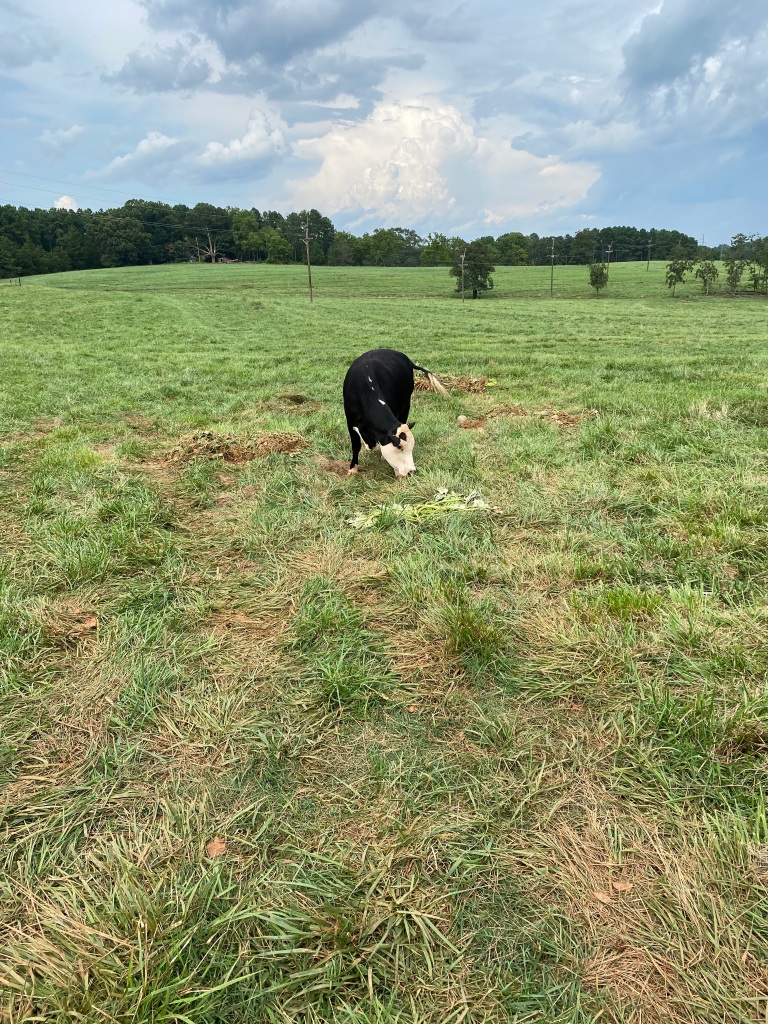
This year, my blackberry crop was a bust. If you follow me on FaceBook you know that we have beef cows which are always a source of entertainment and consternation, depending on the day of the week.
In late April 2024, Harry’s mother was hospitalized. One Monday morning, I was getting dressed to go to the hospital and happened to look out our bathroom window where I had a great view of the garden, the pasture and the pasture GATE.
The gate was standing wide open and not a cow in sight. Harry was already at the hospital…….
I slipped on my flip flops, nightgown flying behind me and ran down to the pasture gate, stepping in cow patties all across the yard……I’m glad we don’t have close neighbors. I lost my religion several times.
Anyway, I realized that the cows were all out and about that time a heifer stuck her head out of the hay barn, mooed loudly as if to say Are you looking for me?
Not knowing what else to do, I called another good ole boy, Sammy XXX. Many of you may know Sammy, who is a good neighbor and asked him if he could come and help me find the cows.
Fortunately, they had not gone far—–just down to the other hay barn where Harry keeps the high dollar square bales —-horse quality hay. Of course that is what they gorged on all night!
They had been out all night, eating their fill of the expensive hay and were full and thirsty.
They knew exactly what they had done and when I started encouraging the big 2000 pound Black Angus bull named HarryBull ( there’s another story there….) to get a move on by running into him with the kubota mule then they all ran back into the pasture and made a beeline for the farm pond for water.
Of course they did because they had been outside all night eating everything in sight and they had a powerful thirst!
Later that day, as I surveyed the damage to my yard, bushes and finally made it to the garden spot I realized they had eaten the new growth of blackberries down to the ground. The blackberries had been ready to bloom and the cows apparently had been out all night and had a high old time in my blackberries. So this summer I only got about a gallon of berries to freeze. Gardening is fun but there is always something that can go wrong.
Normally I will sell or give away several gallons for friends who want to make blackberry cobblers for 4th of July and I always make 2 or 3 for us.
Ron G and Jeff S have a standing order for a blackberry cobbler.
I use the Pioneer Woman’s blackberry cobbler recipe.
Anyway, I gather the blackberries when I have them and freeze them whole until I am ready to make jelly. I usually will have 6-7 gallons in the freezer.
Or I will take the fresh berries and make the juice and freeze the juice in a clean milk jug.
That is where having the right equipment is important. I have my mother’s vintage aluminum cone sieve –$26.99 on Ebay and priceless to me and Lord only knows how many hundreds of gallons of jelly, jam, apple sauce, and relish this sieve and implements has seen.
I use cheesecloth and mash the berries as much as I can and then put them in this contraption and let the juice get out.
I make blackberry jelly instead of blackberry jam because jam has seeds and jelly doesn’t.
I make blackberry jelly because the blackberry seed is very hard and you cannot chew it and it is bad to get under dentures. or so I have been told……
I give jelly to the little ladies in my Sunday School class and they let me know right away that they don’t want seeds in their blackberry jelly……..So I get the juice and freeze it or freeze the berries and then extract the juice when I am ready.
I wait until September or October to make jelly except for fig preserves. You have to make them when the figs are ripe. I haven’t tried to freeze figs. I make fig preserves the way Jeanne and Marie made them. I slice the figs, take the ends off and cover them with sugar and let them stand in the refrigerator overnight. This is called maceration and the figs soak up the sugar. I also add a thinly sliced lemon to the sugar and figs. Then I put all that in my pot and just let them simmer on a low slow heat until they get thick.
After that, I put them in jars and process in a water bath for 10 minutes.
A water bath just means you cover the jars with about 2 inches over the top and let them have a low rolling boil for 10 minutes. That sends all the air out of the jar and kills bacteria and makes the lid of the jar seal.
I like to wait until fall because first of all it’s just too hot to heat the kitchen up in the summer making jelly and also I’m usually too busy canning or freezing vegetables to take time out to make jelly.
Let’s talk about blueberries for a bit.
Blueberries are the only plant that I actually bought and planted and after trying them 3 different places in the yard and garden, I finally found that they like to be in a spot near our driveway.
They actually are placed like a shrub would be because they have beautiful foliage in the fall and really look pretty in the yard.
I wanted to plant blueberries to eat because they have one of the highest concentrations of antioxidants of any plant–other than brussels sprouts.
I started eating a lot of blueberries after I finished my cancer treatment because of their health benefits.
I had not had much luck growing them and fortunately, a friend and neighbor had a lot of bushes and she let me pick all I wanted for a small price. This year I was able to get 5 gallons of berries from my bushes which is good because she moved to Florida and her place was sold and my copious blueberry supply was gone.
I eat a lot of the blueberries but also make a jot of blueberry jam and some blueberry syrup for pancakes. Blueberry jam is okay as to the seeds because they are soft and don’t have the same kind of seed that blackberries have.
Okay, so let’s talk about making jam, jelly, jalapenos, artichoke relish, fig preserves, pickled okra, pickled beets, green tomato relish.
We know that so many things were pickled by our ancestors because it was a good way to preserve fruit and vegetables for winter. Vinegar and salt will preserve just about anything. Before the days of freezers and reliable ways to can and preserve the bounty of the summer, that’s why you canned or pickled just about anything
although some things I see pickled don’t sound like they would be fit to eat.
I love to make pickled okra and add some jalapeno or chili peppers to it to give it a little kick. I grow a lot of beets and remember that good mulch dirt I mentioned earlier? Put that down in the row where the beets and onions go and they will do wonderful in the soft rich soil because they are root crops.
Anyway, we eat a lot of beets. I love the Harvard beets. Harry loves pickled beets cold with a meal or in a salad. They are easy to do with just some vinegar, sugar, and some cinnamon. And you can make them even if you don’t grow them.
Just buy the cheapest can of sliced beets you can find at the grocery store. Take a sauce pan and add the juice from the can, water, vinegar, sugar, a stick of cinnamon, boil it and pour it over the beets you have put in a jar.
Let them sit in a Mason jar in the fridge for up to 3 months. You can adjust how vinegary they are.
When making jelly, the biggest thing is to remember to have all your implements, ingredients, utensils, laid out and easy to get to.
It happens so fast that you cannot be looking for an ingredient, a jar, or a spoon at the moment.
And plan on having 30 uninterrupted.
minutes per recipe.
I’m no rocket scientist. I have learned to follow the directions on the Sure-Jell box to the letter and be successful every time.
You cannot guess and substitute when making jam or jelly because if you do, it might not set and will be runny.
Sometimes a jar doesn’t seal correctly so it either goes in the refrigerator or freezer or sometimes I put a new lid on and run it through again and it will seal.
When I make peach jam, Harry prays that one won’t seal and it will go in the refrigerator. It doesn’t last long in our house. Peach jam is his favorite.
Our grandson Mason loves blackberry jelly on his PBJ.
I try to use a good quality jar like Ball or Kerr. Other brands you see are just not that high quality. I have people who want to give me used jelly and pickle jars all the time and unfortunately, I am not able to use a lot of them unless they are a regular canning or jelly jar like a brand name. You may see the Prego spaghetti sauce jars that say Mason and have measurements on them. They look nice but they are not good for canning or jelly.
When I can vegetables, I use a pressure canner and some of the jars you see pickles and jelly come in will not hold up to the pressure.
I use a water bath canner to process all my jam and pickles–10 minutes at a full rolling boil.
Most directions say if a recipe contains vinegar, you only process 5 minutes. But I’m simple minded. I just do everything for 10 minutes and I don’t have to think about it.
My mother used paraffin on top of her jelly to seal it. I have never tried that mainly because I just don’t understand the science behind it and I don’t like the idea of an oil-based product touching my jelly. If I did do that, I could use some of the jars because it is not being subjected to a lot of heat.
Now I see people comment on some of these cooking and canning sites on FB that I look at and people swear by those jars but I am not comfortable using them and certainly not if I sell a jar of something I have done. It has to be right to leave my kitchen.
So, if you have Sure Jell, about 25 pounds of sugar, and several gallons of fruit you can make jam or jelly.
I start off by getting the water in my big canner going and heating up, then I put the jars I am going to use in hot water to get them tempered because if you put scaling hot jelly in a cold jar, it will crack…..
You also have to have the lids and rims for the jars in hot water on the stove. This kills any germs and also gets everything hot and ready to seal.
I measure out the fruit and sugar first.
I have a special 5 quart pot I use to make the jelly and I put the fruit or peppers or whatever in first, then the Sure Jell, about a tablespoon of butter that keeps down foam, and start heating it. Low and slow is to start with and then you can adjust the heat to get it boiling.
I leave the empty Sure-Jell box on the counter so I remember I have put it in the fruit. Once you start stirring it, it dissolves and you can’t tell it’s in the fruit. No Sure Jell —- no jelly. Voice of experience……
You slowly bring all this to a boil and then add 5-7 cups of sugar depending on what berry you are using.
Bring all this to a rolling boil for 1 minute.
This boils for 1 minute.
Jelly and jam is mostly sugar.
I have a first cousin whose wife is diabetic and she loves my blueberry and peach jam but just can’t eat it.
This year, I experimented with making very low sugar for her. I used the pink low sugar box of Sure Jell and put 1 cup of Splenda in it. She says it was very good and didn’t make her blood sugar go crazy.
No phone calls or interruptions at this stage!!!!!
NOW by this point in the process, I’ve managed to get the hot jars out of the dishpan they were in and on a clean towel on the counter, and get the hot jelly off the stove.
Depending on what fruit you use, the boiling action will make a foam collect on top of the jelly mixture. You have to take a metal spoon and very carefully get the foam off and discarded. If you leave it, it makes the top of the jelly in the jar look ugly, although it’s perfectly fine to eat. All the time being aware that you have scalding juice you are fooling with.
After I use my ladle to get the jars filled………
This is a very important step. If what you are preparing is thick, like tomatoes or vegetable soup mixture, you always want to run a spatula along the sides of the jar and around the inside and middle to let any air pockets escape. Air in the jar will cause things to go bad.
With the jam and jelly I don’t have to do that but I do take a clean damp paper towel and run it all around the rim of the jar before I put the lid on.
If you have anything on the rim that might cause the rim not to sit properly and it won’t seal. Like a pesky little blackberry seed.
Get the rims on the jars good and tight and ready to go in the canner. In the meantime, my water in the canner is not boiling but really hot so when I put the hot jars in, nothing cracks. The jars have to be covered by at least 1-2 inches of water. As I said, I process everything for 10 minutes.
If I am canning vegetables and using the pressure canner, there is a guide you use to know how much pressure and how long.
After the 10 minutes is up, I lift the jars out of the water and start listening for the “ping” of the top sealing that lets me know the jar is sealed.
Sometimes they all seal seconds out of the water, and others take longer…kind of like kids. Some take a little longer to process.
You can tell by a little indentation in the lid and I can also tell by thumping the top and the sound lets me know it has sealed.
I will also go back and tighten the rims on the jars again.
During the day, the next wait and see is if the jelly or jam “sets” or gets the consistency of jelly. Remember it is runny when it goes in the jars. The Sure-jell or pectin is what makes it set up. Usually this happens within 1-2 hours. I have had some take 6-8 hours to set. The box says to allow 24 hours.
I’m giving you all some hot pepper jelly today and it is not as firm or set as I would like. It happens. But depending on how you use this, it will be fine. I have a neighbor who used hers with meatballs and she said they were delicious. I just eat mine with cream cheese and crackers.
I always write the date on the lid of the jar. I like to use all my jelly and things up in a timeframe of 18 months. I have had canned things that are 2-3 years old but I don’t like to go longer.
Several years ago, Ginny W got me onto artichoke relish. She had a recipe that one of her customers in Inman had given her years ago. Laura W had a patch of the Jerusalem artichokes or sunchokes in her yard and they gave me some of the “chokes” to plant. I’ve got pictures of what they look like. The plant looks like a little sunflower or daisy when it blooms but it grows tall.
I have mine in a spot in the yard that is not the best place right now and will probably move them this spring. It takes about 2 years to get enough roots going that you can afford to dig them up and not deplete them. So these plants bloom all summer and you wait until fall to dig up the little chokes. Doing artichoke relish is truly a labor of love because you have to do a lot of work to get the finished product.
The little chokes have to be washed a lot because they have been in the dirt. Then the outside skin has to be peeled or knocked off. Some recipes don’t call for that but I am never able to fully get all the red dirt off them so I end up peeling them. You add the other ingredients and refrigerate overnight. Then add the spices and process according to the recipe. It is absolutely delicious with food as a condiment like chow chow or just on crackers. Mine only comes out on New Year’s Day to eat with collards. It really gets special treatment because it is so laborious to do. Regrettably, I don’t have any artichoke relish to share because I can’t keep it. It is a hot commodity.
We’ve always had bell peppers in the garden because I love to freeze them for stuffed peppers or cut up to use in salads, casseroles or spaghetti. I started growing hot peppers several years ago. I don’t eat hot peppers by themselves like some people do but I love to use them in pickled peppers and hot pepper jelly. I’ve made something called Cowboy Crack that is sweet jalapeno peppers and spices, just straight pickled jalapenos to use in chili and with Mexican food. I also have just plain pickled hot peppers.
Several things I make call for a lot of bell peppers like the artichoke relish, pepper jelly, and green tomato relish.
Bell peppers are expensive in the store. When we plant our garden, I go to Piedmont Garden and buy several colors of bell pepper, a green one called Big Bertha, and yellow and red called California red or green.
Again, I freeze the bell peppers and jalapeno peppers to make pepper jelly and artichoke relish. When I make the green tomato relish, I will use fresh bell peppers. I don’t ever make tomato relish until the tomato fields are open in NC and that’s where I depend on Hilda to be the Paul Revere of the tomato fields and let us know they are open.
Harry McMillan would skin me alive if I picked our tomatoes green to make green tomato relish.
No tomato will be picked before its time in his garden!
As it is, I have to sneak to get a green tomato to make fried green tomatoes or wait for one to fall off the vine for some reason.
Anyway, we will go up to the tomato fields and get green tomatoes to make the relish.
I have also started growing my own onions in a large quantity to put in all these relishes I make because it is so much easier and cheaper to do.
We can harvest the onions in late June and let them cure and they will keep until October at least.
So to close, a couple of things.
You can make goodies like these with a little patience, a good supply of fruit or veggies, the right equipment, some good instructions and the time.
The rewards of making things from your kitchen, with love, and sharing the bounty that God has allowed you to have is like nothing else. The sense of satisfaction I get from knowing that I have made this and know that it is pure and wholesome is a wonderful feeling.
It is very rewarding to see the jelly pantry filled with all the fruits of our labors–and I say OUR because Harry is a very important part of the process with the garden and helping me take care of things……
And to know that our relatives and friends will also be enjoying goodies from Cathy’s kitchen.
It is so gratifying to have people ask if I am going to be making this or that…..I have some folks who have a standing order for peach jam and artichoke relish.
Our DIL Shelly works at SRMC and she works very closely with the CEO or something. Anyway, she told me a few weeks before Christmas that he came into her office and asked if your mother-in-law made any jelly this year? “
To which she replied I’m pretty sure she did. He said–well peach and blueberry are my favorites–hint hint. We got a good laugh out of that. And of course, he got a nice gift basket of jelly and jam.
Around 2018, a first cousin of my husband, Jessie Ann, called and said she had a picture of “Uncle Ellis” that she wanted to give me. Her Uncle Ellis was my husband’s father–David Ellis McMillan– so I definitely wanted the picture. I rode the short distance over to her house where she showed me this beautiful walnut framed photo of a handsome young man in a suit and fedora. I knew this wasn’t my father-in-law, Ellis McMillan. I had seen pictures of him as a young man, so I said to Jessie Ann, “This is not Ellis. Who is this?”
She replied that this was her mother’s Uncle Ellis which would mean he was also my father-in-law’s Uncle Ellis. I had never heard of this Uncle Ellis so I wanted to find out more about him. Jessie Ann couldn’t tell me much about him but I graciously took the picture of Uncle Ellis home because of the family name–Great Uncle, father-in-law, and now a great grandson named Ellis. The picture now has a special place in our home.
To this point all I knew about Walter Ellis McMillin was that he never married, died in 1918, and was a younger brother to Jesse C. McMillin, my husband’s grandfather. He is buried in the New Prospect Baptist Church cemetery.
In 2020, I was helping with plans for the 200th anniversary of our church (1820) New Prospect Baptist Church, Inman, SC, and was talking to another family member who was very well versed in the history of the New Prospect community and the McMillin family. As we were looking at a list of New Prospect church members who had served in wars from Civil to Vietnam, I noticed Walter Ellis McMillin’s name on the list from WWI.
This family historian was more than happy to tell me about Walter Ellis McMillin. I have added a few details from my research but as we reflect on this Memorial Day 2024, I’d like to share Walter’s story.
Memorial Day, originally known as Decoration Day, is a federal holiday in the United States for honoring and mourning the U.S. military personnel who died while serving in the United States Armed Forces. From 1868 to 1970, it was observed on May 30. Since 1971, it has been observed on the last Monday of May.
Walter Ellis McMillin was born in the community of Fingerville, SC on January 20, 1895. According to my family historian, when he was in his teens, maybe 15-16, he was kicked in the chest by a mule and suffered chest and lung damage. Apparently, he had weak lungs from that point forward and was “sickly”. This would have made Walter around 22 when the United States entered WWI in April 1917.
My family historian relates that Walter received his draft notice in the summer of 1918. His father and older brother,Jesse, made a visit to the local draft board office in Spartanburg County, SC, to appeal for Walter to not be drafted due to his poor health. In spite of their best efforts, Walter was drafted on September 30, 1918 and sent to Camp Jackson, now known as Fort Jackson, in Columbia. He was placed in Company D, Battalion One, in the Provisional Developmental Brigade. The Provisional Developmental Brigade was a brigade of men who were considered not physically ready for combat who needed extra physical training and strengthening before being sent to the front lines.
Walter’s service record notes that he was drafted September 30, 1918 and died of bronchial pneumonia on October 11, 1918. The war would officially be over in exactly one month from his death. One can only imagine a sickly young man with breathing problems being put through strenuous physical activity. He was only there 11 days before succumbing to bronchial pneumonia!
A few years before the family historian passed away, he asked me to come and visit him. So our grandson, Ellis, and I went to see him. He was Max Trout. Uncle Max gave me the award seen below with the inscription. It had been in his possession after being given to him by Walter’s nieces, Frances and Jewell.
Even though he never saw combat, the Republic of France awarded him a certificate of appreciation for giving his life for freedom.
It reads in French and here is my translation:
“A memoir given to Walter McMillin, Private First Provisional Development Brigade from the United States of America, who died for liberty. This is the pendant of war from the country of France from the president of the Republic.”
Walter’s mother never got over the loss of her son, which was in her mind, senseless and wrong. She refused the obligatory life insurance payment his family received after his death and gave the money to two living sons to do with as they saw fit. Since Frances and Jewell were in possession of the award from the French Government, I have to assume she wanted no part of that either.
Walter Ellis died in October 1918. In 1921, his older brother Jesse and his wife, Sally, had a son they named David Ellis. I have to believe that this Ellis was named after an uncle he would never see who, while he never stepped foot on a battlefield, gave his life in the service of his country. We have a grandson named Ellis after his great-grandfather, but whose name also honors that of a young 23 year old man who never had the chance to live his life just like so many other men and women who gave it all for their country.
MCMILLIN, WALTER 4~92077 Res Spartanburg SO NA Spartanburg Co SO Sept 30/18. Br New Prospect SO Jan 20/ 95. Co D Cas 5 Bn 1 Prov Dev Brig Cp Jackson SO to death. Pvt. Died of Broncho Pneumonia Oct 11/18
This is the first installment of stories from my fabulous trip to Ireland, Scotland, and London in April/May 2022. After two years of disappointments due to postponements because of Covid, my friends, Phil, June, and first cousin once-removed, Vivian, finally got to have a truly wonderful experience.
A little background before I launch into the topic of this blog–OMAGH, 2022.
I toured Ireland in 1966 with my mother and Aunt Gail. We had gone to London to visit my brother, Daniel, and his young family. He was working in advertising in London and a chance to visit him and see his new little daughters was a dream trip for us, especially for a Grandmother. While in London for about 8 weeks the summer of 1966, we took a week long tour of Ireland. This was a life-long dream of my Aunt Gail’s.
Aunt Gail was the family historian and genealogist. I’ve written about her before because she was such a special influence in the lives of all her nieces and nephews. She never married and had children of her own and she absolutely doted on all of us.
Aunt Gail had been working on the White family history for quite a while and her stories as passed down from Grandfather White (Bernard Hendrick White) were the stuff we grew up on. So a lifelong dream of Aunt Gail’s was to visit Ireland from whence our White family originated. But there was a catch.
She had to fly in an airplane to get there. Aunt Gail was deathly afraid of flying. That is all. For all her worldly experiences as a professional woman who worked for the Governor of West Virginia, well-read and intellectual, she had a few hang ups. She never learned to drive and flying was out of the question.
In May, 1966, we took an ocean liner, The SS United States, from New York to Southampton and the boat train on to London. But to get to Dublin to begin our Irish tour, we would have to fly. We had been scheduled to go by train to the coast and then take a ferry to Dublin but the ferry operators were on strike that summer of 1966 so the only way to get to Dublin and back was by plane. Auntie Gail repressed her fear of flying. Her lifelong desire to see the land of our ancestors and the town from which William G. White had hailed –Omagh–was greater than her fear of flying.
So, it was in 1966 that we visited Ireland and Omagh.
Ireland 1966 I am second from left on the back row next to the statue. Mama is to my left and Aunt Gail is first on the left, second row.
I’ll insert Aunt Gail’s own account of that visit to the home of our ancestors from her Emigrants from the Emerald Isle family history that she authored:
William G.White was born in Omagh, County Tyrone, Ireland. The date of his birth is not known. However an entry in the Bible of Elijah Parlow, now in possession of Mrs. John F. Ellison, Red Bluff, California, states: “William White b 3/15/1751 m Catherine Hook (Hoke) b 6/9/1762, m 1802. William White, Jr. b 1/24/1787”. As will be noted later, William G. White’s son William was not born in 1787, but he married Catherine Hoke. We know that William G. did marry in Ireland but the name of his wife was Hunter, but the date of marriage and her death are not known. The dates in the Partlow Bible entry referring to William White could be correct, with only the name of his wife and the birth date of his son William Jr. in error. He could, also, have had a son born in 1787 but with another name. It could also be that the entry does not apply to anyone in our line.
Note from Cathy: I am in possession of a leather needle case, complete with needles that belonged to Catherine Elizabeth Hoke.
Aunt Gail further writes, “ We had understood that the home from which the emigrants came was a large stone house in Omagh. In 1966, my sister Evelyn, niece Catherine, and I had a week’s tour of Ireland and since we were to go through Omagh, we were on the alert to see the ‘large stone house’ , which we understood had been their home, being certain we could identify the home of our ancestors. However, we were dismayed to find that ALL the houses in the small town were stone, and learned later that in all of Ireland the houses are stone, timber being scarce and costly.
Over the years, my sister and I have laughed with love, at Auntie Gail’s belief that she would actually see the house of our ancestors in Omagh. As long as she lived, I believe it was a great disappointment to her that she did not see William G. White’s large stone house on that fabulous trip to Ireland.
And so I bring us to April 23, 2022. My first cousin once-removed, Vivian, and I connected via Ancestry and Facebook about a year ago. Her grandmother and my mother were sisters. Vivian and I had never met in person but realized an instant connection through our love of family history and interest in genealogy and family research. A desire to see Ireland and visit the land of our White ancestors was compelling and so it was that Vivian joined my local friends and me on this trip.
After a long flight during the night, our little group arrived in Dublin on Friday morning, April 22 and were free until Saturday evening before joining our tour group. I’m not sure whose idea it was, but Vivian and I decided to visit Omagh on Saturday as it was about 2 hours from Dublin in Northern Ireland. Vivian set out to further research the White’s of County Tyrone and try to see if she could dig up any more information than what we had from Auntie Gail and Ancestry. My task was to secure a car and driver for the day.
Vivian was lucky in that she located a very loquacious local historian in County Tyrone who was chock full of information about Whites. I have since learned that while the surname White does not sound particularly like an Irish name, they were, in fact, quite plentiful in the area.
Vivian had information about Cappagh Parish Church, about two miles from the town of Omagh, where Whites were buried. And so armed with what information we had, the four of us, my traveling friends from home, June and Phil, set out on a White ancestral search.
Des was our driver. He was a font of information and did not simply drive. He entertained, he explained, he pontificated, and he told stories. Our ride to Omagh took about 2 hours and I wish I could say it was a beautiful scenic ride but it was not. Ireland has a wonderful system of modern new highways and on each side of the highway are very tall hedges and plantings that totally block the view of anything on the other side. I am sure that from the other side of the hedge, those who live and work there appreciate not seeing the traffic and hearing the noise. It reminds me of the huge concrete barriers one sees in the Atlanta area–they serve a purpose but one does miss seeing scenery.
One difference I noted from my trip to Ireland in 1966 and now, fifty-six years later, was the new modern roads. In 1966, our bus traveled narrow backroads where it was not unusual to see little families of children with their dogs and ponies standing beside the road poised for photos and being given coins in exchange for the photo opportunity. We saw many small thatched roof cottages along the way. Not so on this 2022 trip. For most of the time spent going from major site to attraction, we were on the modern highways and I saw very few thatched roof cottages. The reasons are because Ireland is a much more prosperous country than it was in 1966 and those who can afford it have upgraded their simple stone cottages with slate roofs and modern improvements. We also learned that the ancient craft of thatching is a dying art and the craftsmen who can do it are few and far between.
We arrived at Omagh and saw a lovely, bustling town of around 50,000. Clearly larger than it was when William White lived there! We drove on through town and went about 2 miles out into the countryside where we found a small lane that took us down to the beautiful Cappagh Parish Church, a Church of Ireland (Anglican) congregation. The church is surrounded by lovely fields and pastures with a very strong river called the Strule River. Our driver Des, the fount of information, told us that it was evident that this church historically had been influential and wealthy because it was built of sandstone that had to be imported rather than the plentiful rocks and slate that are characteristic of Ireland.
We knew from our internet searches and Vivian’s contact in Tyrone that a David White was buried in the church cemetery. We got out of our van and immediately the four of us set out on a rather haphazard perusal of the large cemetery! I had looked on FindAGrave.Com and while some graves in the church were recorded, I was dismayed to find no Whites listed at all. Many of the tombstones were faded and in bad repair as is to be expected in a very old church. While we were there, a couple came into the cemetery armed with a weed-eater and rake and went deliberately to a section of graves inside a beautiful wrought iron fence. Thinking these people would surely know where the Whites were buried, I approached the lady and asked her if she knew where any Whites might be buried. She replied that she did not and purposely went back to her weed eating but she pointed to her companion and said he might know something. Her companion was an elderly man, white-haired and with the clearest blue eyes I have ever seen. He was deaf as a post. I asked him if he knew where any Whites were buried but he didn’t understand me so Des tried to interpret. Mind you, we are all speaking English! Des spoke to the man in such a brogue that I have no idea what he said and the gentleman’s reply was nothing I could understand but Des did determine that the gentleman knew that Whites had lived in the area but if they were buried here, he did not know. Des told me that the gentleman had a most distinctive dialect or brogue and he called it something but for the life of me I don’t remember what he said.
Vivian, June Gardner, and Cathy in front of Cappagh Parish Church
While I was trying to understand English in front of the church, I heard Vivian exclaim that she had found David White! We had been searching all around the graveyard when David White rested almost next to the right rear corner of the church, indicating that it was one of the older graves in the cemetery. The church was built in 1768 and the earliest gravestone is 1775.
Cathy at the grave of David White. Is he a long lost relative?
Vivian and I excitedly took pictures of the grave, a large slab of stone beautifully engraved but hard to read due to aging and weathering. The earth under the large slab had shifted and the heavy stone had broken on one end and was unceremoniously propped up by a huge rock. Sadly, it appeared to me that families may be responsible for the upkeep of their family burial plots as some were well-tended and others, as in the case of David White, were in poor condition. Not having the information to make that assumption, it may be wrong and if so, my apologies to the church congregation.
I’m a firm believer in God Winks, those unexplainable coincidences that are not coincidences at all but rather God reminding us that He has a sense of humor and enjoys helping us to understand His omnipresence. As Vivian and I were absorbing the enormity of finding the grave of David White, who may or may not be a relative of days gone by, the bells of the church began to chime at the hour of 12 noon.
It was an incredibly awe inspiring feeling to hear the bells echo across that beautiful land.
I can’t really give adequate words to describe how being in that place where my ancestors must have trod, whether to that church, down that lane, perhaps toiled in one of those fields, or maybe fished in the river we could see from the church yard made me feel.
Cathy and Vivian at Cappagh Parish Church over looking the Strule River
I got a sense of completeness and purpose and coming full circle.
Des asked me if I could feel it.
“Feel what? “ I asked.
He said, “It’s in the green grass, it’s in the air, it’s in the soil, it’s in the stones. If you are Irish it’s in your DNA and you can feel it.” Until he gave that explanation for it, I really couldn’t comprehend how I felt but his words gave substance to my feelings.
As we were traveling back to Dublin where later we would join our tour group for the evening’s activities, Des shared that he had done some acting and commercials in the 1970’s. He said that he had worked in London. I told him that my brother had lived in London from 1965 until 1993 and that he was a very successful creative advertising executive having owned several companies. Des asked which ones and I replied Cromer-Nadler and Cromer/Geer. Des said that he had worked for them doing some commercials for British Exxon. “Yes, I exclaimed! He did design an ad campaign for British Exxon.” We decided that in all actuality Des had probably met my brother and worked with him. Another God wink for sure!
I have to acknowledge that this trip to Omagh was to honor Auntie Gail and try to add to the information we have about our family origins in Omagh thanks to her. We haven’t made a definite connection to David White and our William G. White–yet. Vivian is still working on that. But I have to believe that if he was a White and he lived in Omagh, there is a connection. We will find it!
We didn’t see any white stone houses in Omagh on this trip. Our time was limited as we had to be back in Dublin by 4 and that only allowed for the church visit and lunch on the main street of Omagh. But we did fulfill a dream that very few people get to do–visit the place where one’s ancestors once lived and perhaps visit the final resting place of a long lost relative!
Recently, I posted a blurb on Facebook about the prayer rock that Harry moved into a new place for me. I thought I would share the backstory of how I got the prayer rock and some of the experiences I have had there over the years. This will be a little more biographical than just gardening. Be forewarned. I think it must have been in the late 1980’s that Harry bought a new Massey Ferguson tractor that had a big front-end loader on it. This works like a bucket and can be moved up and down to move material. I don’t know why we were riding around in the pasture on the tractor; maybe so he could “play” with the new loader and show me his skills. The far border of our farm property is a stream. It is not a very bold stream and is spring-fed in several places, but in one particular place there was a natural waterfall and many large rocks along the bank. I am pretty sure that some of these large rocks are part of some of the same boulders that we used to make my rock retaining wall and all might have originated from the same geological event at some time in the long past. Anyway, Harry saw a large flat rock and said he thought that if he could get it with the bucket, it would make a nice seat or focal point for my garden area. Even then, he knew the way to my heart was with rocks! So, after much maneuvering and manipulation with the bucket, the large flat rock and several others were transported to the house. We set up the rock seat near the edge of the woods that border our yard and there it sat for many years. It was only recently that it got a new place in the garden. It didn’t start out as a “prayer rock”, only a nice flat rock that was nice to sit upon and reflect. But it is hard for me to be outside in nature, listening to the birds, smelling the fragrant flowers, looking at the blue sky and the mountains in the distance without my thoughts and my adoration turning to God. And so, over the years, the rock became for me, a place where I could sit and commune with God. But there have been times when instead of communing, I cried out in pain, sadness, bewilderment, and faith. My mother went going through a battle with cancer, which ultimately took her life and over the approximately three years she was sick, I found many occasions to sit on the rock and pray for her healing, her comfort, and at last, her deliverance. During those long days, I would sit on the rock and ask God to guide me and help me to be a good daughter to her and do everything I could to honor her and help her last days be as happy and free from worry as could be. Mama showed us all how a Christian approaches death with faithfulness and grace. I like to think that that the faith that sustained me through that time came, in part from sitting on the prayer rock and talking it through with God. Fast forward several years, and I was serving as principal at New Prospect Elementary School. I had been principal there for 8 years, and during that last that year, I had become burdened and convinced in my heart that my effectiveness and leadership were waning. I have an educational administrative theory that the longer a person remains as a principal in the same school, sometimes it becomes harder to make the tough decisions that have to be made. Over time, you become close to the people in the school, you live through many life experiences with them, and you become friends and family. That makes it hard to lead and even harder to have those tough conversations with friends and even harder with family. But as the leader of a school, you have to be able to do this if the organization is to continue to thrive and goals met. So that is where I was in early spring 1999. It may not be true for every administrator but for me, I was becoming increasingly aware that I needed to make a change. However, I did not want to leave District One. I remember sitting on the prayer rock one cold day in early spring when I got home from school and having a very frank conversation with God. “God, you know that I am not feeling good about my leadership at New Prospect. And you also know that I am not applying for jobs, I don’t ever want to leave District One, and I am really at a loss. So, I’m giving it all to you. If you want me to be principal at New Prospect, then you give me some assurance that I am doing the right thing and I am going to give it all and be the best one I can possibly be. But, if you don’t want me to be principal there, then you are going to have to take care of it because I am giving it to you!” It was certainly an audacious way to talk to God, but I think He appreciates our honesty and our frankness with Him. I gave it to Him, and quite honestly, forgot about it. Over the next few months, I dove deep into planning for the next three to five years of things I wanted the school to accomplish and the direction I wanted us to go. I wanted the school to be a Palmetto’s Finest winner. I went so far as to say we should be a National Blue Ribbon School! I met with teachers and enlisted their help with where I thought the school should go and how we would get there. I felt confident, renewed, and ready to face the next few years at New Prospect. Apparently, God wanted me to stay right there! Then, something happened that I could never have anticipated and even today it remains one of those singular life events that will always be a bad memory. A disgruntled employee accused me of something that could ultimately cost my position and bring much discredit to the school. Over a period of about 10 days, while we were dealing with the allegations, I spent many an hour sitting on the prayer rock in anguish with God. I couldn’t believe that this was happening. I am basically a very trusting person, and it is hard for me to recognize when people are just bad, evil, and manipulative. I couldn’t believe that an employee would be so vindictive as to accuse me of a crime.I distinctly remember sitting on the prayer rock and crying out to God. “God! I know I said if you didn’t want me to be principal of New Prospect, you would have to take care of it…but I never meant that I wanted to go to jail!” I can laugh about that now, but I wasn’t laughing then. I was able to weather that particular episode, but that is not the point of sharing this experience. Many times we offer up prayers to God and then try to answer the prayer ourselves. I had forgotten about the prayer and challenge I gave to Him. God does hear our prayers and He answers them in His own time, and often in ways that we could never dream of. If I have learned anything in the experiences I have had in my Christian walk, it is that we can’t fathom how God works so that is why we just have to trust Him. His ways are not our ways and we can’t even imagine how He makes provisions for us. Remember, I said to God while sitting on the prayer rock…”God if you don’t want me to be principal of New Prospect, you take care of it. I’m giving it to you.” Certainly, that was the last thing on my mind as I struggled with the allegations of that former employee. The middle of May arrived and I was deep into planning for the next year, testing, and end of year activities. Sadly, the mother of one of our teachers passed away quite unexpectedly. The Superintendent and I were going to another city to visit with the family. I remarked that I had read where a longstanding principal in another good Spartanburg County school district had resigned to go to a place I considered less desirable to work. “I could possibly see myself leaving New Prospect to go to District ______maybe, but down there? I don’t think I could do that.” He looked over at me and said, “Well do you see yourself leaving New Prospect to go to Mabry?” Well, suffice it to say that knocked me for a loop and it was one of the rare times I was left speechless. As far as I knew, there wasn’t a vacancy at Mabry. Then I heard a still small voice speaking in my right ear. Really, that is what happened. “Cathy, you gave it to me.” That was all. “Cathy, you gave it to me.” Then and there, I knew that God had heard my prayers, and even though I thought that He had forgotten that bold challenge I had issued to Him, He had not. I knew that the Superintendent didn’t say things like that without meaning it. I knew what he was asking. And there was no stalling for time or asking for time to talk it over with anyone. I knew that God had spoken and that He was in the midst of this conversation. I looked at the Superintendent and replied, “Well, I have always said that I would do whatever God and ________ _______ asked me to do.” His response to me, which we still laugh about it today, was, “ I don’t know about God, but this is__________ talking!” On June 14, 1999, I was named principal at Mabry Junior High School. Psalm 62:7On God my salvation and my glory rest; The rock of my strength, my refuge is in God.
Psalm 62:2He only is my rock and my salvation, My stronghold; I shall not be greatly shaken.
The word “home” means a lot of things to us depending on the way it is used. We hear words and phrases like home-base, hometown, homey, homework, home is where the heart is…. You get the idea I’m sure.
In this blog I am reflecting on my childhood home, the first home I remember. It was a good-sized two story brick and stucco-accented home with stately pecan trees, a large backyard, a cow pasture, a garden spot, and chicken houses. It was located at 828 Reidville Road, Spartanburg, SC. I was born in 1950 and lived there until my parents bought a business in the nearby town of Inman and moved there in 1958. My parents built a new house and the home I knew for the first 8 years of my life was sold to a family with young children. The sale of the home provided income to my parents for a good many years. I recall vividly that they “self-financed” the home for twenty years and the family who owned it would regularly come to our house in Inman to make the house payment. The times have certainly changed!
You won’t find my childhood home there now. You won’t even find street number 828. The house was torn down several years ago in the name of progress. I’ll come back to that later.
You won’t find Reidville Road. It was renamed the John B. White Boulevard in 1998 to honor a very fine man and leader in the city of Spartanburg. If you’ve ever eaten or heard of TheBeacon then you know about the legacy of John White. I still call John B. White Boulevard the Reidville Road and I probably always will in my mind. It is and was a thoroughfare that I have traveled many times in my life to get to places of business and to visit relatives who lived on the Reidville Road. I remember when sidewalks were put in and a once country road leading out of town became a busy thoroughfare into the downtown area for the new families living in Woodland Heights and points west.
It seemed to me, in my child’s way of understanding, that our house was huge. By today’s standards, it would be considered comfortable and roomy but modest. There was a nice front porch, partly covered and partly opened. I spent many happy hours on that porch playing with my dolls and coloring in coloring books. The house had a living room with a beautiful fieldstone fireplace. The fireplace stones had been collected on the place, so we were told, and it was beautiful. Some of the rocks had shiny mica and quartz in them. That fireplace was my mother’s pride and joy. She loved to decorate it for Christmas and always had a vase of flowers sitting on it. I believe her love of rocks and mine, too, for that matter, had its origins in that fireplace. The dining room had built-in corner cabinets on which my mother proudly displayed her china and vases. When they built the new house in Inman, the corner cabinets went in the dining room in that house. The kitchen seemed large but it probably wasn’t. It had a little breakfast nook with built-in bench seating and a large walk-in pantry. Off the kitchen was a large back porch that had windows and housed the washer and freezer. Mama kept African violets in those windows. No dryer for us! I loved to play in the sheets and other clothes hanging on the clothesline. I remember that Mama would get a little aggravated as the neighbor kids and I ran through her freshly laundered sheets and grabbed them with our grubby hands!
Cathy and her daddy in the kitchen
Near one side of the rear of the house was a combination root cellar and green house. I can still smell the earthy fragrance of good loomy dirt and plants. The root cellar had a door that led to a full basement. Mama had shelves on three sides of the basement full of her canned vegetables and jams and jellies. I was not a fan of the basement because in one corner sat a huge coal furnace that had to be fed coal and stoked in the winter. There was a hatch on the side of the house where the coal man would send the coal down into a big bin near the furnace. I can still visualize my father in the early morning, going down the steps to feed the coal furnace and get the house heated up for the day. I was afraid of the furnace and rightly so. If you saw Home Alone when MaCaulay Culkin’s character goes into the basement and sees the monster furnace, you know how I felt. A byproduct of the coal furnace was the coal cinders that had to be removed periodically from the furnace. They were small rock hard and sharp shards of residue that did not burn. Daddy would spread them out in the driveway along with the gravel. One did not dare walk barefoot over the cinders!
There was a white clapboard garage with the huge double doors that had to be pulled open to either side to let the car go in. It was covered with an old-fashioned pinkish salmon colored rose called “Talisman” that had the most wonderful fragrance. The rose bush and many other plants went with us when we moved to Inman. Mama rooted some of that rose for me and I planted it near one of our barns but it didn’t survive. I’ve never been able to find that rose. I wish I could.
The fireplace in the living room decorated for Christmas
We had chickens and a milk cow. My mother made butter. My father had enough chickens that he could sell the eggs in the mom & pop grocery store that he operated near the downtown of Spartanburg. I had a horse–my first horse– named Molly. She was an old, gentle plow horse and I loved her. It seems hard to believe now, especially if you were to ride down the four-lane road that is John B. White Boulevard, but I would ride my horse from our house out the Reidville Road on the shoulder of the road a distance of a mile or so to the intersection of Blackstock Road and the Reidville Road and back. I was 6 years old! Times sure were different then.
The bulk of my growing up was spent in our new house in Inman so that is the home I have the most memories of and it still stands today and is inhabited by family. But the house on Reidville Road still has a large place in my memory. I had playmates and classmates surrounding me. The side streets off Reidville Road were filled with new young baby-boomer families. We played for hours in the creeks and woods and our parents never worried about where we were or what we were doing. I had two aunts and uncles who lived on Reidville Road near us. Aunt Sybil and Uncle Mack lived down the street and as I walked to school to Park Hills Elementary School, I could count on a stop by to see Aunt Sybil and visit for a while on my way home from school. I could always count on a treat of some sort from her. Up the street, lived my Aunt Lenora and Uncle Frank and my paternal grandmother. I was surrounded with playmates, relatives, and an idyllic life. We had good neighbors. The Tinsleys lived in the house on our right. It still stands and is an exact replica of our house only flipped so the rooms are opposite our house, much like the new construction homes that are 20 feet apart. On the other side were the Perrys. There were three Perry children, Eddie, Carol, and Linda. We played hard. The other house below us belonged to Dr. John Simmons. He was the local dentist. He was very nice and seemed somewhat old to me as a six year old. He probably wasn’t even 50! I have this memory that his wife was not in good health so we kids avoided the Simmons’ yard when we could.
The Cromer Family at 828 Reidville Road: David, Bill, Martha Gail,Evelyn, Cathy and Daniel
Rhw
We’ve heard it said that “we can’t go home again”. In most respects that is true but today, I did go home again to my childhood home. I took our grandchildren on a visit to Hatcher Garden and Woodland Preserve on John B. White Boulevard in Spartanburg. The address is 820 John B. White Boulevard. The main entrance and what they call the “The Park at Hatcher Garden” is exactly where my house at 828 Reidville Road stood. As best I can tell from researching the records, the house and my parents’ two lots were sold to the Spartanburg County Foundation in 1992. At some point after that, our house was torn down. I remember reading that it was to be torn down and had plans to try to retrieve a brick or a rock or something from the homeplace but I did not. The huge pecan trees that I played under are still standing. The water wise demonstration garden with drought resistant plants is exactly where my mother had her flower garden of iris, daylilies and other perennials. When she moved to Inman, she transplanted a lot of the iris and daylilies. I have some of the same varieties in my garden. She also had a passion for rocks and moved many of her treasured rocks to Inman. I have one very substantial rock with quartz crystals and other interesting formations. I think that it needs to return home to a special place in the Hatcher Garden somewhere my mother might have trod.
The office and gift shop for Hatcher Garden is in the old Tinsley home. Our pasture and place where the hen houses were is now wooded and populated with beautiful plants, trees, and walkways. it would be hard to imagine that it was ever an open pasture. In the history of Hatcher Garden, we are told that Mr. Harold Hatcher purchased acres of old eroded cotton fields and gullies. I beg to differ with that somewhat. The portion of the land that is Hatcher Garden that my parents owned was not eroded and washed out. I’m sure the history is referring to some of the property that was on the extreme backside. It is hard to believe now when traveling through Spartanburg and the west side of town, that this was at one time, mostly farms and open country. There was a World War I army camp located near the intersection of Highway 29 and Interstate 26. But our property was well-taken care of. I don’t know how much land my parents owned at 828 but I know it was enough that we had a large garden, the pasture, and near the back of the property a house that they helped my sister and her husband build. The road down to that house is now a service road for Hatcher Garden. I am anticipating taking a walk down that road to see if the house is still there. That is for another walk and another time.
The Tinsley house in the background–now the Hatcher Garden offices
The grandkids and I had a very nice walk on the beautiful grounds of Hatcher. The yards that once belonged to my family, the Perrys and the Simmons are now verdant plantings of native plants and beautiful hydrangeas and other plants. The Simmons’ yard is now a pond designed to catch storm water from the drains along the four lane road where natural processes can purify the water and return it back to the ground. The walkways meander through “rooms” where one can sit on beautiful granite benches and enjoy the songs of the birds and the chirping of squirrels. The sounds of the busy highway are muted by all the sounds of nature and bubbling streams that fall over man-made waterfalls. Even on a muggy June day, we were cool and never really ‘broke a sweat” as we walked the various paths and read the engravings on the many memorial stones scattered around the park. I think that placing a stone in my parents’ memory is the next project on my list. I know what the engraving will be:
A kiss from the sun for pardon
A song from the birds for mirth
I feel nearer God’s heart in my garden
Than anywhere else on earth
The open park-like area near the front of the garden is the most meaningful part of the place to me since it is where our house stood. As we walked along the gravel path, I tried to explain to the grandkids, 6 and 9, what this place was and why it was important to our family. I think that we have to tell our children about their family, their history, their grandparents and those gone on in order for them to have a sense of belonging and understanding of who they are. If we want our children to have a sense of worth and self- acceptance, they need to know that they are loved and came from families of people who worked and lived and worshipped and made contributions to the communities in which they lived. I try to take every opportunity I can to share some of their family history with them just as my aunts and uncles did with me. I’ll show some pictures of the house and my family–my parents, siblings, and me in happy times and routine times at 828 Reidville Road.
Our grandchildren sitting near where the yard was.
The park at Hatcher Garden which is where our house stood.
I’m thankful to Mr. and Mrs. Hatcher for having a vision all those years ago and for those that have made the vision of an urban garden oasis along a busy street come to fruition. The alternative could be that I would ride by a falling in, decrepit, once beautiful home now overgrown with kudzu and littered with graffiti, garbage and trash. Sadly, we can ride down the roads in any community and see many such homeplaces that were once thriving and viable, now eyesores. My heart would surely break if that is what I saw when I rode down the Reidville Road past 828.
It’s true that I can’t go home again to that house that stood at 828 Reidville Road, but somehow as I walked the paths with my grandchildren yesterday and walked across our “front yard” to stand under the pecan tree I played with dolls under, I knew that I was home.
As long as I have my memories, even though the physical place looks nothing like it did 70 years ago, I will know it as “home”.
I’m just happy to be here and be alive. Fourteen years ago last week, I underwent a mastectomy to remove my right breast due to breast cancer. I’ve detailed that journey in other posts but as I celebrate this milestone this October, I am just happy to be alive, healthy, and able to enjoy a wonderful life here on the farm in my retirement. I know that breast cancer is a sneaky disease and it could rear its ugly head again in my body so I don’t ever get “cocky” as we say in the south and think that I have beat breast cancer. I am a survivor for 14 years so we will just leave it right there.
Today was an absolutely gorgeous day here in upstate South Carolina. I didn’t have any appointments or errands to do today and it felt so good just to let the day unfold. We have a grove of Black Walnut trees on the farm and Monday I took the Kawasaki Mule and a big tub that had held 50 pounds of cow minerals in it and went over to the walnut grove to see what I could find. The trees were loaded and I came home with a tub full of black walnuts with hardly any effort except to bend over and pick them up which is good exercise for this lady.
Harry did some internet research on the best way to get the huge outside hull off the walnuts. So mid morning he said he wanted to tackle getting the hulls off the walnuts. I jumped at that because I figured I would end up doing it by myself, walnut preparation not a favorite activity for most folks. And besides, he had some recently cut hay on the ground that would not be ready to work on until after lunch today so he had some free time. I think he was anxious to see if the internet suggestion would work. We spread the walnuts out on our asphalt driveway and then he ran over them with the front tire of his trusty John Deer tractor. It worked like a charm! The outer hull was mashed and the hard inner nut just popped out. Now before the reader thinks this was an easy chore, let me tell you it is not! Black walnuts have a distinct odor and the juice is nasty and it stings. I wore rubber gloves and Harry wore leather work gloves. Black juice gets everywhere and stains everything. The old t-shirt I had on today went in the garbage because I was afraid the walnut stain would ruin a load of clothes. I know why the pioneers wore a lot of dark brown. They used the juice of the black walnut as a natural dye! Once we mashed the outside hulls and started popping out the nuts, we noticed that the nuts were covered in little white worms. Our internet source said that the worms were harmless to the nut and wouldn’t damage the meat so we continued but those little worms sure looked nasty! After we got all the nuts out of the hulls, my tub yielded a bushel of nuts, which we washed and sprayed with the garden hose. The next step was to spread them out on the wooden floor of an old hay wagon to dry out in the sun. We will get as much of the outside residue off the nuts and let them cure about a month before we start the next phase of cracking the hard nut to get to the good stuff.
My tub of Black Walnuts!It is easy to see how nasty the process can be!
After our success this morning and seeing how easy it was to get the process started, I decided to go back to the grove and get more walnuts. That bushel of nuts will only yield about a pound of nut meat if we are lucky, so more nuts were needed if I am to do the baking I have planned with those walnuts.
As I approached the walnut grove, I saw two Red-tailed hawks take off from the top of a huge oak tree near the walnut trees. I have seen one of the hawks just about every day sitting on the top of a power pole in the pasture and also in the top of some tall pine trees that border the pasture fence. Hawks have a distinct call and when I hear it, I look up in the sky and will usually see one gliding over the fields. Harry did some cleaning up with the bush hog along the fence rows yesterday and he commented that the area was full of field rats. (Ugh). The grass is tall and he did not cut it for hay again after August so there are plenty of seed heads for them to eat. I’m pretty sure that the reason I have seen the hawks in this area is because of the field rats. Nature takes care of itself if we just stay out of the way. And as long as those field rats stay in the FIELD, I will be fine with that. I am sure that between the coyotes and the hawks, the field rat population is maintained in a natural balance.
Fencerow where Harry mowed the grass.
The pair of hawks circled around the area where I was for a little while, making their calling sound all the time. I don’t think they were happy that I disturbed their perch and hunting. I watched them until they flew over the tops of the tall pines and disappeared.
I stopped by one huge tree that was loaded and I figured that I would find a lot of walnuts under it but apparently they have not started to fall from that tree. Perhaps I will check it out later if I think I need more nuts. I went on to another tree and found the ground covered and as I picked up walnuts more were falling to the ground with a loud “plop”. Fortunately, I wasn’t hit by one. Some of them are the size of a baseball and feel as hard as one. They could do some damage if they hit you. In fact, some of them had hit the ground so hard that they had made an indentation in the ground and appeared like a huge green Easter egg that had been hidden deep in the grass.
These are all walnut trees.
In no time, I had another tub full of walnuts. I also had my pants legs and socks covered in some kind of sticky seed that came off some weeds I saw and really didn’t pay attention to until I was covered with the sticky things. When I got home, I had to hand-pick every one of those little suckers off my pants!
After I finished gathering the walnuts, I just sat in the Mule and enjoyed the sounds of the blue jays and bluebirds. I could hear the walnuts dropping to the ground as a slight wind would blow.
The air was crisp and the fragrance of goldenrods permeated the air. Thank goodness I used my Flonase this morning or I would have been sneezing my head off!
My thoughts turned to how peaceful and calming it was to be sitting out in the middle of a pasture, surrounded by huge old walnut trees, listening to the sound of the birds and the leaves. I had to give thanks to God for allowing me to be alive in this moment–it could have not been that way. I silently thanked Him for allowing me to enjoy this beautiful day in a place I love, doing something that gives me joy.
I couldn’t help but contrast that with all the “noise” that is in the world today and especially in our country. It is the noise of fear and concern over a disease that we can’t seem to figure out how to combat. It is the noise of so many differing opinions and conspiracy theories that one is left just wondering what or who to believe. It is the noise of a contentious and highly emotional political climate and I would wager that most people do not desire that for our country. It is the noise of so much that is unfair and just flat out wrong about how we treat each other. I could go on and on but you get the idea. NOISE. Just stop. Just breathe. Just listen.
God speaks to us in the silence of a beautiful autumn afternoon. He says to listen to his still, small voice. He says that he knows that we are worried and confused. He says that we need to remember who is the author of all creation and who knows how this will all end. He says to listen to the birds–remember that I told you that they don’t worry about anything. He says to look at the leaves and the grasses and remember that the seasons come and go, the leaves wither and die but He is eternal! He says to look no further than the walnuts and remember that he provides for us and meets our needs. He says to put our trust in him and don’t worry about tomorrow. He says to give thanks in all things–even field rats, for they serve a purpose. He says to look to the clear blue skies where the mighty hawks soar and know that we have a home prepared for us in Heaven.
“Be still and know that I am God; I will be exalted among the nations, I will be exalted in the earth.” Psalm 46:10.
“The heavens declare the glory of God, and the firmament proclaims His handiwork.” Psalm 19:1
Today was the first day of school for the students in our area. This is the fourth year of being retired for me and finally this year, I didn’t get a little sad that I was not going back and that I wasn’t right in the thick of things. I loved my career in education but I am loving retirement too. I stay so busy that I don’t have time to miss it. I am doing things I want to do, along with a few things I have to do, but usually it is on my own time and my own schedule. I’ve always loved to garden and work in our vegetable gardens but working full time all year meant many long nights preparing vegetables for the freezer or canning and my flower beds were never quite up to speed by this time of summer. Now I have time to work in the yard and vegetable garden every day. This year, having a big yard and flower beds with something always needing to be done, as well as the vegetable garden, has been especially calming. The virus has made going places something to be avoided if possible and the “lockdown” was challenging. But thanks to plenty to do around here, I wasn’t bored and didn’t get cabin fever.
This weekend, I worked on collecting flowers to put in our church on Sunday. I love to be able to provide fresh flowers for our altar. I got this honest. I can remember many Sundays during the year that my mother would provide flowers from her yard that she had arranged for our Methodist church in Inman, SC. Artificial flowers are very pretty these days and some arrangements appear so real as to be hard to tell that they are not. However, I was brought up with the idea that real, fresh flowers on the altar in church represented the living God that we worship and they signify life. I know that these days a professional florist arrangement worthy of a church altar can be very expensive week after week and is a luxury many churches can’t justify. That’s one reason I like to provide flowers for our church when I can. The other reason is that it is a form of worship for me…..to thank God for allowing me to have the health and opportunity to work in my garden and grow flowers and to thank Him for the beauty of our world.
I had planted a lot of yellow and orange-hued flowers in anticipation of our church’s 200th anniversary celebration that was supposed to be held on June 7 and 8, 2020, but of course that was cancelled due to the virus. It was rescheduled for August 30 but again, we had to cancel. Some theories hold that the beautiful rural community in which we live, New Prospect, got its name because early settlers prospected for gold in the surrounding creeks. In fact, our local elementary school used to be the Prospectors back in the day before becoming little wildcats.
I had planted zinnias, Mexican sunflowers, and regular ornamental sunflowers along with the other foundational plants in my flower garden–hydrangeas, gardenias, summer flock (phlox), butterfly bushes of several colors, and roses. We wanted to use flowers from our yards and gardens for our celebration instead of flowers from a florist since we figured in 1820, our church founders would have used what they could gather from the fields if they had flowers in church. So, this past Sunday I did an arrangement that was mostly yellows, oranges and golds. I usually try to cut the flowers early in the morning and do the arrangement on a Saturday. I bring the arrangement in my kitchen and place it over the AC vent in the floor so they will stay fresh until Sunday. This past Sunday, since we are not having Sunday School due to the virus, I got up early and cut the flowers and took them to church and then arranged them in a vacant classroom prior to our 10:45 worship service. Next Sunday I will provide another arrangement but this one is going to be all shades of pink zinnias and butterfly bush blooms.
Today was a very pleasant day for August, 80 degrees and very low humidity. That is a rarity for our area this time of year so Harry and I tackled the summer garden and cleaned it up. The cantaloupes are all finished except for one late patch so we pulled the vines up. They have been very prolific and absolutely delicious this summer. We planted two kinds, Ambrosia and Athena. Both of these are a very sweet melon. I drove the bobcat while Harry put the vines and small cantaloupes that won’t mature in the bucket of the bobcat. We pulled up the squash plants because they had gotten infested with worms, a usual occurrence this time of year, and besides that we were tired of squash and I had frozen all I wanted to freeze. So the squash plants went in the bobcat too. I pruned all the tall asparagus fronds and made that bed look neater. I also had to scalp the raspberry plants in their arbor because they had sent out a lot of shoots and these had taken off with all the rain we had. They made it hard for me to walk between them and my raised beds so they had to be contained. Raspberries are very invasive and if you don’t keep them pruned and contained, they will take over.
I drove the bobcat into the pasture and dumped several loads of garden waste into a ditch. We don’t compost this because if there are diseases in any of the plants you don’t want to perpetrate that in your compost. Besides that, we have a ready solution to getting rid of the garden waste–the cows! They love nothing better than eating the vegetation we throw over the fence. I am sure that squash plants, cantaloupe vines with a few green cantaloupes thrown in is a great treat when you are eating nothing but grass all day long. Today, most of the cows were in another part of the pasture but one old savvy cow heard the bobcat and saw that I was dumping some sort of vegetation. She came running to the cantaloupe vines and started gobbling up all the green baby cantaloupes before the other cows could get there.
I did throw the raspberry and asparagus trimmings in the compost bin and they will provide some nitrogen and green material to aid in the composting process.
Then we spread my horse manure! Now to the non-gardener, one might wonder why I get so excited about horse manure! It is good stuff, the best fertilizer ever and all natural. Cow manure is not that good unless you buy it in the form of Black Cow because it has too many weeds and grass seeds in it. Horse manure does not. We are fortunate to have several horse farms in our area and one local stable owner let us put some big tubs at her farm. She had her stable hands empty the horse manure that they had removed from the stalls in our tubs. We had a pretty good sized pile that we have been letting cure for several months. We took this and spread some in one of my raised beds. I’ll work it in with my little Mantis tiller and probably plant some fall broccoli or beets in the bed next week. Another local fellow has a business where the stable owners pay him to haul off their manure and sawdust. He has been bringing us 2 or 3 trailer loads of this great mixture all summer. We are letting him dump it in our pasture. It is a huge pile now. We will let this sit out all winter and “cure” and then early next spring–February or so, we will spread it over our garden area. I can’t wait for this stuff to go in our garden!
Next on our list was for Harry to till up the ground that we had cleaned up. He has a tiller that is pulled by a tractor. It is a life saver and really does a good job of preparing the ground. I’ll go in with a rake and smooth an area that I want to plant turnip greens on. I’ll do a 20 X 20 plot and that will give all the turnip greens and turnips we want for us to eat and share with friends. I like to plant a mixture of purple top turnips, mustard, and kale. This gives a nice mix of greens with different flavors and I get beautiful turnips later in the fall. I know that turnip greens and turnips are an “acquired taste” but I love them.
Another part of the garden will be for my collards crop to go in. I’ll plant about 64 plants to sell and give away to friends and neighbors. We are getting a little head start because I don’t usually plant the collards until mid September. I always try to plant the turnip greens by Labor Day.
We did all that in the morning and worked until around noon. Then I came inside and started canning tomatoes. Our tomato crop this year was a bust. We worked very hard on our tomatoes and planted them twice but both times they took a disease called wilt and had to be pulled up. I bought tomatoes from a friend who has a friend who grows tomatoes for a popular produce stand in Spartanburg. He said the tomatoes were not good enough to sell at the produce market. I didn’t care what they looked like because I was going to quarter them and put them in jars anyway! I love to can vegetables. I know that I could buy tomatoes at the grocery store cheaper than I can process them myself. But the money is not the issue. There is something very rewarding about growing your own vegetables, knowing how they were grown and what was put on them, doing it yourself and knowing you are providing for your family. I guess the old hunter/gatherer concept is kicking in. Anyway, I had about 14 jars of quartered tomatoes that I will use in soups, stews, chili beans, spaghetti sauce, and just eating right out of the jar this winter. Then I had 6 jars of okra and tomatoes together. This will be for preparing vegetable soup. I’ll add some other vegetables using my mother’s recipe. All I’ll need to do is add a hot pan of cornbread and we will have a filling, nutritious meal for several days.
I use the canner that my mother gave me in 1973–Harvest Gold no less! It is a pressure canner. I know some folks are afraid to use a pressure canner but I am not. As long as you read the directions and do what it says you are fine. The thing about my canner is that I have to pull a chair up and sit right in front of the stove and watch it. The pressure that is recommended depending on what you are processing requires constant monitoring. So I pull up a chair, get the library book I am reading, and relax for 25 or 40 minutes depending on what I am canning.
At the end of the day, I am tired but it is a good tired. The garden looks neat and clean and is ready for fall planting. I have 20 jars of vegetables ready to go in the pantry for this winter.
We were eating lunch today when I looked out the dining room window to the pasture where I could see one of the Black Baldy cows. She was lying down alone in the shade of a tree near a ditch that separates one big pasture from another. There is a wet weather creek that runs through the ditch. The ditch is about 20 feet deep and the creek fluctuates with the weather. I commented to Harry about seeing the cow and he said that was probably “Whitey” who was due to calve any time. We looked through the binoculars and sure enough, she was in labor. A cow in labor will roll around, look back at her tail area, lie flat, and get up and down. This was not a young cow having her first calf so we were not too worried that she would need any help. Our grandson, Mason, is visiting us for several days and was excited at the prospect of seeing a calf be born. I was a little anxious for that because I wasn’t sure his parents would want a five year old witnessing the full experience of a calf being born and if something went wrong, that wouldn’t be good. But the opportunity to witness a new birth and share the experience with our grandson was strong so off we went. Now on the farm, there’s no need for CHE (comprehensive health education/sex ed) because there are plenty of opportunities to discuss the birds and the bees–literally. Our sons will attest to the fact that there were plenty of times we explained and answered questions about procreative activities on the farm. We finished up lunch and headed down in the pasture riding in our Mule but as we were headed towards the spot where the cow was, we saw her stand up and turn around and look to her backside and we knew the calf had been born. That’s probably a good thing. Wouldn’t want to traumatize a 5 year old. Anyway, when we got there, we noticed Whitey was being kept company by another older Black Baldy cow. I asked my husband the cow’s name and he said this cow doesn’t have a name because she was not born on the farm and is a little wild. Our cows that are born on the farm are tame and not afraid of people. My farmer husband says he won’t have a cow he can’t get his hands on. Well, somehow this no name cow has stayed because she does bring pretty calves.
It is a little unusual for a cow to have company when she gives birth. They like to be alone and most of the time the other cows will give them that privacy but that was not the case today. I guess old No Name was there for moral support. But as we shall see, she was there for a purpose. Which leads me to this thought. What things look like are not always as they appear. Have you ever had one opinion about a person–maybe not that nice of an opinion— or maybe you stereotyped him or her, only to completely change your mind about the person once you got to know them? In these very trying days, I think we all need to be very open-minded about situations and try to see all sides before taking a stand or forming an opinion. It looked like No Name , who now has a name sort of like “Who’s On First” , was in the wrong place at the wrong time but she really wasn’t.
As we approached the cow and calf we kept our distance and stayed in the Mule. As I said, most of our cows are very tame but a new Mama Cow does not play. They are very protective and it is usually a few days before they will allow us to get near a new calf. This new calf born today has black patches over each eye and a pretty patch of white on her shoulders. Since she was a heifer, Mason and I decided to name her Patches. Before we knew what sex the calf was we had decided on Pirate if it was a bull calf and Patches if it was a heifer calf. Calf properly named, we were ready to watch what unfolded.
Whitey immediately started licking Patches, especially around her face and getting her cleaned up, like all good cow mamas do. At the same time, she was nudging Patches in an effort to get the calf to stand up. We explained to Mason that this is a very important step for animals born in the wild since they have to be able to move and run to protect themselves from predators. About the only predator we have on the farm is the occasional coyote and fortunately, we have never lost a new calf to a coyote. Patches immediately started trying to get up, wobbled around and fell several times. Whitey wasn’t helping the situation because she was continually licking the calf and making her unsteady on her feet. The last time she fell, Patches fell down along the rim of the big ditch. The ditch was 30 feet away from where she was born but still she managed to fall in the edge of the ditch. I had just commented prophetically to Harry that the calf “was going to mess around and head straight for the ditch–watch it.” And of course she did! I was afraid she would fall all the way down. The ditch is wide and the cows walk in it but the sides are steep and it is not the best place for a new calf to be trying to learn to walk and nurse. Whitey was very upset, bellowing and bawling, and the other cow came over to commiserate with her. The more agitated the two cows became, the more perilous the calf’s situation became. It was trying to get up but couldn’t because she couldn’t find a place to stand and get purchase of solid ground. Harry, being the kind farmer that he is, decided he would have to pick the calf up and move her to a safer place. Easier said than done because Whitey was not at all happy about having a human touch her baby. Harry tried twice to get near the calf but 1000 pounds of upset mama wasn’t having it. Here, I am reminded of shepherds in the Bible, who would look for the wayward lamb or goat and take it to safety. I’m sure that Patches would have been okay had she fallen all the way in the ditch, but then she could have been injured or fallen in the creek and drowned. Harry was looking out for the calf, just our Heavenly Father looks out for us. And–get this. He puts people in our paths to help us. We just need to be aware and accept the help. Or in this case, it was a No Name Black Baldy cow.
As I said, Harry was having no luck getting close to Patches. Every time he would move toward her, Whitey would sling her head, bellow loudly, stomp and paw her hooves and clearly communicate that he better keep his distance. All of a sudden, No Name, who had been watching all this from about 30 feet away came to the rescue. She came charging up to Whitey, and unbelievably, got in Whitey’s face and started bellowing and butting her! This cow made Whitey move away and farther down in the pasture enough for Harry to get his chance to get close to Patches. He tried to pick the calf up but she was still wet and slick from being born ( don’t even think about what it was ) and she slid out of his arms. And the fact that she probably weighs 80 or 90 pounds wasn’t helping matters either. I suggested he take his shirt off and use it to grab the calf ,which he did. He was able to move the calf far back from the ditch and Whitey was right on the spot as soon as the calf was moved and put down in the grass. The other wise old cow, No Name, having done what she was sent there to do, went on her way to the pond where the rest of the cows were cooling off in the shaded water. When we left the pasture, Patches was standing up on her own and had found her mom’s milk bag. She had not started nursing yet but we know she will be fine now.
No Name isn’t as popular as some of the other cows. You might even say she is not as loved as the others. She is wild. She is not tame like the rest of our cows. But she was in the right place at the right time today. I have no idea what goes through a cow’s brain and why No Name was keeping Whitey company today is a mystery to me. But I do know that this cow probably saved Patches’ life or at the least, made her entrance into the world a little less perilous.
We find ourselves in places, situations, and circumstances and often we don’t know why we are where we are or how we got there. We have to wait on God to show us the purpose. He puts people in our paths and we don’t know why. I have learned after many years and many experiences to accept that God is in the details and wait for Him to show me the why.
I have learned to accept that unexpected things are not coincidental or luck. It was no coincidence today that No Name was keeping Whitey company. Let’s all be a little more aware of our circumstances and look for the purpose that God is trying to show us.
( Harry’s shirt went in the garbage).
Whitey is taking care of Patches shortly after her birth.Farmer Harry is looking at Patches in the rim of the ditch at Whitey guards.Whitey is taking care of Patches as No Name looks on.